
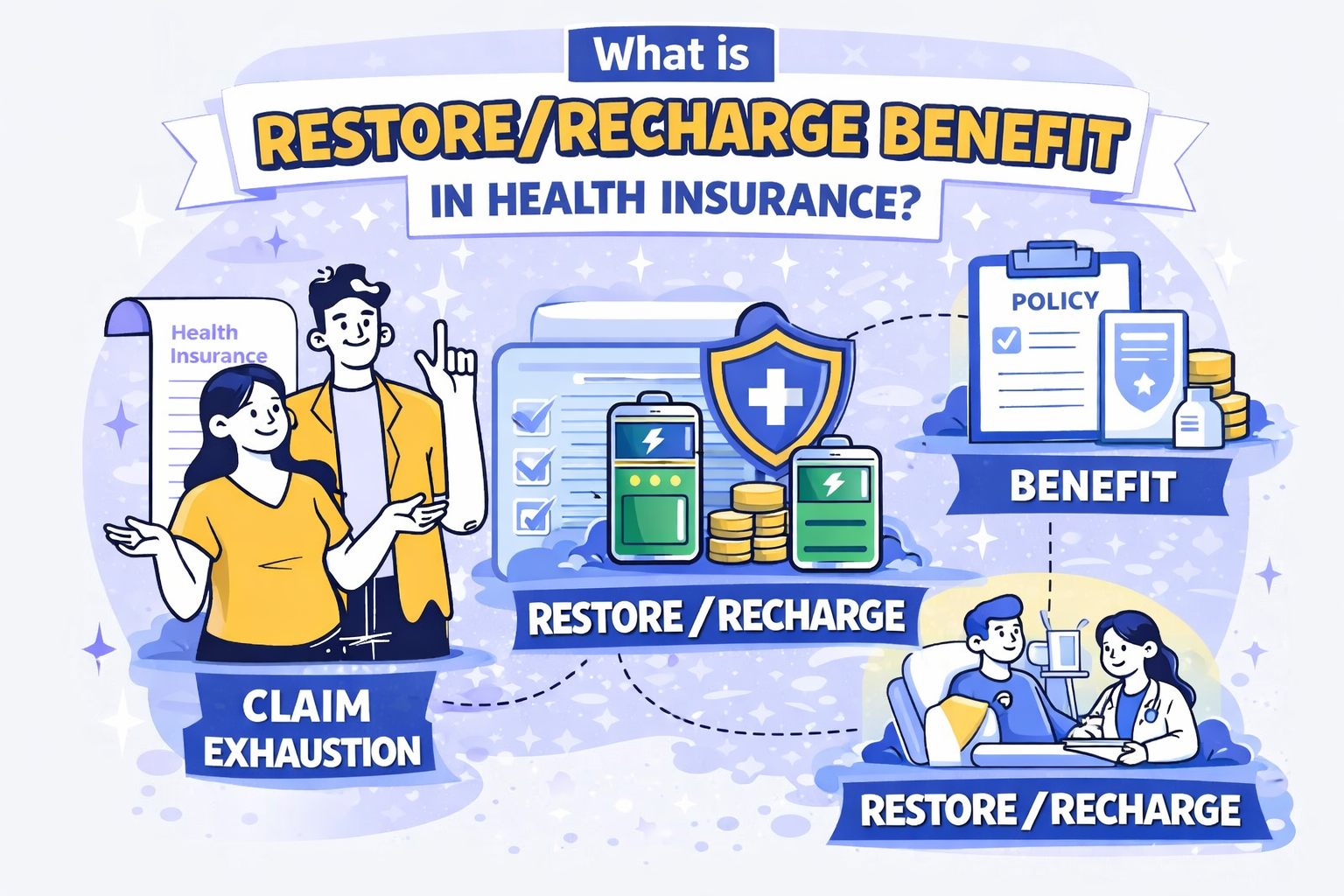
Health insurance has a hard limit: the sum insured. Once it is exhausted in a policy year, you are on your own for any further medical expenses — unless your policy includes a restore or recharge benefit. Understanding this feature precisely, including its limitations, is one of the highest-value things you can do before buying or renewing a health insurance plan.
What Restore/Recharge Benefit Does
When your sum insured is fully used up in a claim, the insurer automatically replenishes it so you are covered for subsequent hospitalisations in the same policy year.
Without restoration:
- Policy: ₹10 lakh sum insured
- Claim 1 (May): ₹9.5 lakh hospitalisation → Insurer pays ₹9.5 lakh → Remaining SI: ₹50,000
- Claim 2 (September): ₹6 lakh hospitalisation → Insurer pays ₹50,000 → You pay ₹5.5 lakh out of pocket
With unlimited restoration (different illness):
- Policy: ₹10 lakh sum insured + unlimited restoration
- Claim 1 (May): ₹9.5 lakh hospitalisation → Insurer pays ₹9.5 lakh → SI restored to ₹10 lakh
- Claim 2 (September, different illness): ₹6 lakh hospitalisation → Insurer pays ₹6 lakh in full
Total paid by insurer: ₹15.5 lakh from a ₹10 lakh policy — because restoration activated.
The Vocabulary: Restore, Recharge, Reinstatement
Different insurers brand this identically-functioning feature with different names:
| Insurer/Plan | Term Used |
|---|---|
| HDFC Ergo Optima Restore | Restore |
| Niva Bupa Reassure 2.0 | Recharge |
| Star Health Comprehensive | Automatic Restoration |
| Care Supreme | Unlimited Reinstatement |
| ICICI Lombard Complete Health | Sum Insured Reinstatement |
All of these functionally mean: sum insured replenishment after exhaustion. The differences lie in the conditions — not the name.
The Most Important Distinction: Same Illness vs Different Illness
This is where most confusion arises and where the actual value of restoration benefit is determined.
Standard Restoration (Different Illness Only)
- The restored sum insured can only be used for a hospitalisation caused by a different illness from the one that depleted the sum insured
- If you are hospitalised twice for the same condition (e.g., two cancer-related hospitalisations), the restored SI may not apply to the second claim
Who this disadvantages: Chronic disease patients who require multiple hospitalisations for the same condition annually (diabetes complications, cancer chemotherapy cycles, kidney failure requiring dialysis, etc.)
Broad Restoration (Same Illness Included)
- The restored sum insured can be used for the same illness, the same person, in the same year
- This is the most valuable version of restoration
- Offered by: HDFC Ergo Optima Secure No-Limit, Niva Bupa Reassure 2.0 (in some variants), Care Supreme (with add-on)
If you have a pre-existing condition likely to require multiple hospitalisations, same-illness restoration is not a luxury — it is essential.
Partial vs Full Exhaustion Trigger
Some plans restore only when the sum insured is fully exhausted. A plan with ₹10 lakh SI that has paid ₹9 lakh in claims still has ₹1 lakh left — restoration hasn’t triggered yet.
Other plans restore when the SI is partially used — an even richer benefit. Fewer plans offer this.
How Restoration Works in a Family Floater
In a family floater plan, where all members share the same sum insured pool:
Scenario — Two family members hospitalised in the same year:
- Family floater: ₹25 lakh SI + unlimited restoration
- Member 1 (parent, July): Cardiac bypass surgery, ₹22 lakh → SI depleted to ₹3 lakh → Policy restores ₹25 lakh
- Member 2 (spouse, October, different condition): ₹12 lakh hospitalisation → Paid in full from restored SI
Without restoration, the spouse’s ₹12 lakh claim would have only ₹3 lakh in the SI pool, leaving ₹9 lakh out of pocket.
This is precisely why restoration benefit adds disproportionate value to family floater plans, where the risk of multiple members claiming in the same year is real.
How Many Times Does Restoration Activate?
| Restoration Type | How It Works |
|---|---|
| Once-in-a-year restoration | SI restored once per policy year regardless of how many times exhausted after |
| Unlimited restoration | SI restored every time it is exhausted, unlimited number of times per year |
Unlimited restoration is standard in most comprehensive plans today. Verify whether your policy specifies “unlimited” or has a cap.
Restoration Benefit vs Super Top-Up Plan
Both features protect you when your base sum insured is exhausted, but they work differently:
| Feature | Restoration Benefit | Super Top-Up Plan |
|---|---|---|
| How it activates | Automatically within the same policy | Separate policy, activates when aggregate claims cross deductible |
| Coverage scope | Replenishes the original SI amount | ₹50 lakh–₹1 crore additional cover |
| Same illness | Usually restricted (check policy) | Covered without restriction |
| Cost | Usually included or small riders premium | ₹4,000–₹10,000/year for ₹50 lakh cover |
| Best for | Medium-scale multiple claims in a year | Catastrophic single or aggregate claims |
Best strategy: Use both — a base plan with unlimited restoration for normal-scale multiple events, and a super top-up for catastrophic cover. These are not mutually exclusive and together provide layered protection at low cost.
Plans in India with Strong Restoration Benefits (2026)
Here is how the feature compares across leading plans:
| Plan | Restoration Type | Same Illness? | Activation Trigger | Times |
|---|---|---|---|---|
| HDFC Ergo Optima Restore | Restore | No | Full exhaustion | Unlimited |
| HDFC Ergo Optima Secure | No-Limit restore | Yes | Full exhaustion | Unlimited |
| Niva Bupa Reassure 2.0 | Recharge | Yes | Full exhaustion | Unlimited |
| Care Supreme | Reinstatement | No (standard) / Yes (add-on) | Full exhaustion | Unlimited |
| Star Comprehensive | Automatic restoration | No | Full exhaustion | Unlimited |
| ICICI Lombard Complete Health | Reinstatement | No | Full exhaustion | Unlimited |
Policy terms change. Verify directly with insurer before purchase.
What Restoration Does NOT Cover
Understanding the exclusions in restoration benefit prevents claim surprises:
-
Pre-existing condition waiting period: Restoration does not waive waiting periods. If diabetes complications are still in the waiting period, restored sum insured will not cover them.
-
Sub-limits are inherited: If the original policy has room rent sub-limits, the restored sum insured carries the same sub-limits.
-
Same policyholder, same illness (in most plans): As discussed above, standard restoration is for different illnesses.
-
Restoration carries forward within the year only: The restored SI does not add to next year’s sum insured. It is a within-year replenishment only.
-
Pre-hospitalisation and post-hospitalisation limits: These are typically calculated on the original sum insured, not the restored amount, in basic plans.
Should You Specifically Buy a Policy with Restore/Recharge Benefit?
Yes, if any of these apply:
- You have a family floater plan (multiple members may claim in a year)
- You or a family member have a chronic condition requiring periodic hospitalisation
- Your sum insured is ₹10–25 lakh (restoration provides meaningful amplification; for ₹1 crore policies it is less critical)
- You are the eldest or most health-risk-exposed member covered
It may be lower priority if:
- You already hold a very large base sum insured (₹1 crore+)
- You hold a super top-up for catastrophic cover (which handles the same scenario differently)
- Your policy already has unlimited restoration included in the base plan
In practice, since unlimited restoration is now standard in most quality comprehensive plans and adds minimal cost, there is little reason to choose a plan without it.
Quick Decision Guide
Do you want to be covered if you are hospitalised more than once in a year?
  → Yes → Ensure your policy has unlimited restoration benefit

Do you have a chronic condition likely to cause multiple hospitalisations?
  → Yes → Look specifically for same-illness restoration (Niva Bupa Reassure 2.0,
           HDFC Optima Secure, or a plan with an unrestricted restoration add-on)

Do you want catastrophic coverage beyond ₹50 lakh?
  → Yes → Restoration alone won't help — add a super top-up plan

Are you on a family floater?
  → Yes → Restoration is especially valuable; confirm unlimited restoration is included