
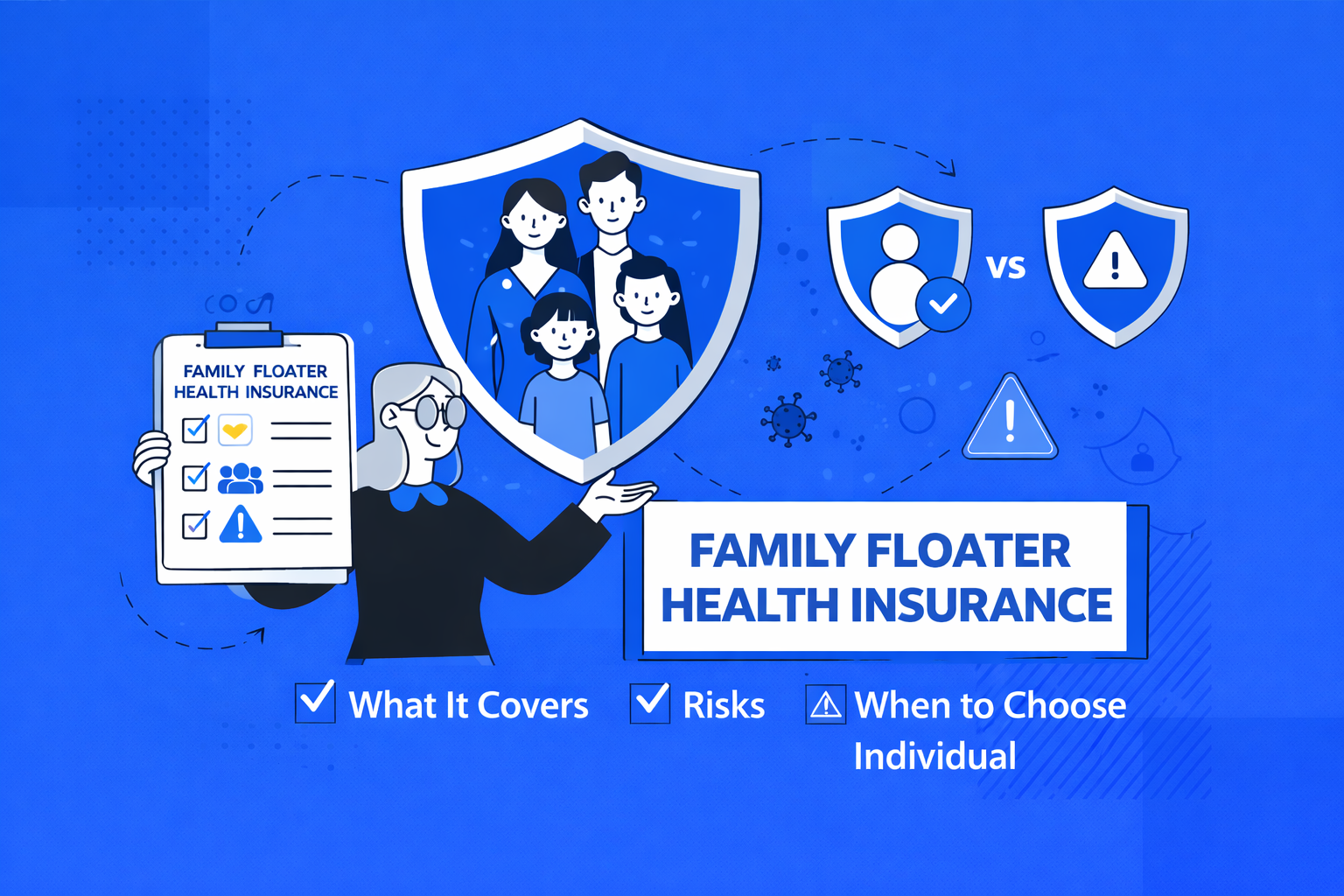
A family floater health insurance plan pools the sum insured across all family members under a single policy. The appeal is clear: one policy, one renewal, and significantly lower premiums than separate individual policies. The risk is less visible: the shared pool structure means a single hospitalisation event can leave the rest of the family with inadequate coverage for the remainder of the policy year.
This guide explains exactly how the mechanism works, the premium economics, the concentration risk problem, and the conditions under which individual policies are the correct choice.
How a Family Floater Works
Under a family floater, the insurer issues one policy covering named family members. The sum insured — say ₹15 lakh — is a single pool available to all members collectively.
Claim scenario (healthy year): No claims are filed. At renewal, the no-claim bonus increases the sum insured or provides a premium discount. All members benefit.
Claim scenario (one member with large claim):
- Family of 4 with ₹10 lakh floater
- Father hospitalised for cardiac surgery: ₹8 lakh claim settled
- Remaining cover for the year: ₹2 lakh for mother + 2 children
- If a child is hospitalised 3 months later: cover capped at ₹2 lakh regardless of actual bills
This is the concentration risk of a family floater. It is manageable for healthy families but becomes dangerous when any family member has a chronic condition or higher hospitalisation probability.
Premium Economics: Floater vs Individual
Family floater premium is typically calculated on the eldest insured member’s age. All younger members are essentially included at a marginal additional cost.
Example: Family of 4 (2 Adults, 2 Children)
| Approach | Ages | SI | Approx Annual Premium |
|---|---|---|---|
| Family Floater | Eldest: 38 | ₹15 lakh | ~₹22,000 |
| 4 Individual policies | 38, 35, 10, 8 | ₹15L each | ~₹55,000 |
| Family Floater | Eldest: 55 | ₹15 lakh | ~₹48,000 |
| 4 Individual policies | 55, 50, 25, 22 | ₹15L each | ~₹44,000 |
Note: Premium figures are illustrative. Actual premiums vary by insurer, city zone, and health declaration.
The crossover point where individual policies become cost-competitive is typically when the eldest member reaches 52–58, depending on the insurer.
The Shared SI Pool Risk
The most important concept to understand about family floaters is how the shared pool behaves when the family includes a member with elevated hospitalisation risk.
Scenario: Family with a Diabetic Member
- ₹10 lakh family floater, 4 members
- Member A has Type 2 diabetes (post-waiting period, so PED covered)
- Member A hospitalised twice in Year 3: ₹4 lakh + ₹3.5 lakh = ₹7.5 lakh claimed
- Remaining cover: ₹2.5 lakh for all other members for the rest of the year
In this scenario, the other three family members are functionally under-insured for 9 months of the policy year. This is why chronic illness in any family member is the strongest argument for separate individual policies.
When Family Floater is the Right Choice
Ideal conditions for a family floater:
- All members are under 45
- No member has a chronic or recurring condition
- SI is at least ₹15–20 lakh (enough that partial exhaustion still leaves meaningful cover)
- Both adults have employer group insurance as a secondary layer
- Budget is a genuine constraint
Sum insured guidance for family floaters:
- Family of 3–4 in a metro city: minimum ₹15–20 lakh
- Family of 3–4 in a Tier-2/3 city: minimum ₹10–15 lakh
- Adding parents to a floater: always consider whether separate policies are more cost-effective
When Individual Policies are the Better Choice
Prefer individual policies when:
- The eldest family member is above 55
- Any family member has a chronic condition (diabetes, hypertension, cardiac history)
- You are adding parents aged 60+ to the family
- The family floater SI would be low (below ₹10 lakh) due to budget constraints — inadequate cover is worse than a well-structured smaller floater
- One member’s high claim probability would consistently leave others under-covered
For parents specifically: Separate senior citizen health insurance plans typically offer:
- Features designed for common senior conditions
- No concentration risk bleed onto children’s coverage
- Specialist products with shorter PED waits for specific conditions
Restore Benefit in Family Floaters
The restore benefit — available on plans like Niva Bupa ReAssure 2.0 and Care Health Supreme — partially addresses the concentration risk of family floaters. When the SI is exhausted, the restore reinstates it, subject to conditions (same vs different illness depending on the plan).
However, restore is not unlimited protection: it activates only after the original SI is exhausted, and some plans restrict restoration to different illnesses. It is not a substitute for adequate base SI.
Common Questions Before Buying
Can I add members later? Most insurers allow mid-term addition of newborns. Adding other members at mid-term typically requires waiting until renewal.
What if I get divorced or a child becomes independent? Members can usually be removed at renewal. Each member then needs their own individual policy.
Are pre-existing conditions covered in a family floater? After the applicable waiting period (typically 3 years per IRDAI’s 2023 amendment), yes. The waiting period runs from the policy’s inception date for each declared condition.
Comparison: Top Family Floater Plans (2026)
| Plan | Min SI | Room Rent | Restore | CSR (FY24) |
|---|---|---|---|---|
| HDFC Ergo Optima Restore | ₹3L | No cap (₹5L+) | Different illness, once/year | 98.4% |
| Niva Bupa ReAssure 2.0 | ₹5L | No cap | Same/different, unlimited | 91.1% |
| Care Health Supreme | ₹5L | No cap | Different illness | 91.0% |
| Star Health Comprehensive | ₹5L | No cap | Available | 99.1% |
CSR from IRDAI Annual Report FY 2023-24. Verify current figures at irdai.gov.in before purchase.
Disclaimer: PolicyJack is an independent research platform. We do not sell insurance, receive commissions, or have commercial relationships with any insurer.