
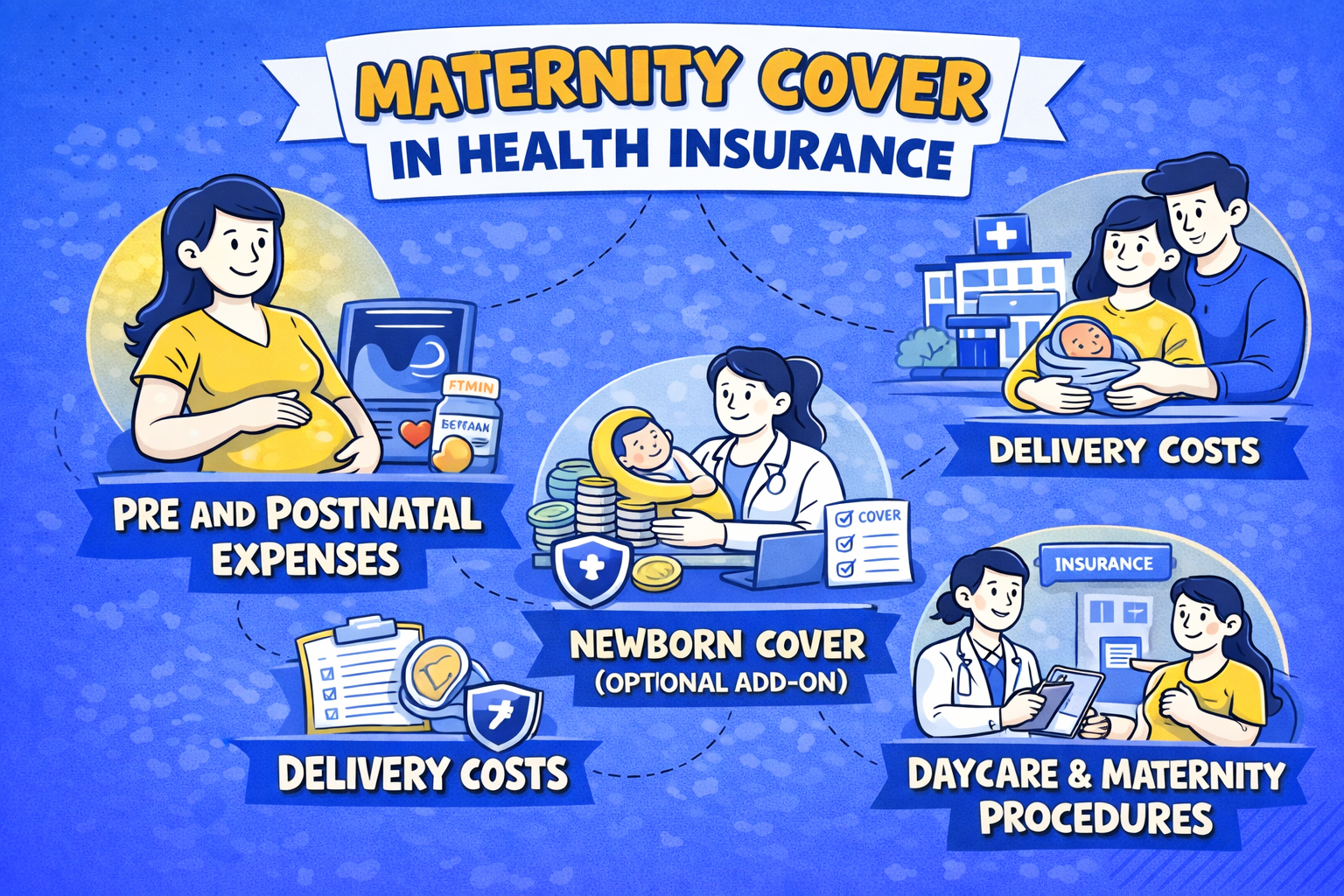
Maternity cover in health insurance pays for delivery-related hospitalisation expenses. The critical constraint is a mandatory waiting period of 2–4 years, meaning the coverage is only relevant for buyers planning ahead. Understanding the waiting period mechanics, sub-limits for normal vs C-section delivery, newborn coverage, and actual market offerings allows you to evaluate whether adding maternity cover is worthwhile for your specific situation.
How Maternity Waiting Periods Work
Maternity cover is never active from Day 1 of a health insurance policy. All policies with maternity benefits impose a waiting period from the inception date before delivery expenses are covered.
Standard waiting periods:
- 2 years: Less common, typically in premium plans or group policies
- 3 years: The most common for individual and family floater plans
- 4 years: Some plans, particularly add-on maternity riders
What the waiting period means in practice:
- If you purchase a policy on 1 January 2026 with a 2-year maternity waiting period
- The earliest delivery covered is after 1 January 2028
- Any delivery before that date is not covered, even if hospitalisation occurs
- The waiting period runs from policy inception — not from when you add maternity cover as a rider
Group insurance exception: Many employer group health insurance policies cover maternity from Day 1 (no waiting period). This is a genuine advantage of group plans and is one reason why employees who anticipate pregnancy should check their corporate policy’s maternity terms carefully.
Delivery Sub-Limits: What’s Actually Covered
Even when maternity cover is active (post-waiting period), most plans impose sub-limits on the covered amount. These sub-limits are typically far below actual private hospital delivery costs.
Typical sub-limits by delivery type:
| Delivery Type | Common Sub-Limit Range | Actual Cost (Metro Private Hospital) |
|---|---|---|
| Normal/Vaginal | ₹25,000–₹50,000 | ₹40,000–₹1,20,000 |
| C-Section | ₹50,000–₹1,00,000 | ₹1,20,000–₹2,50,000 |
| Complications (ICU) | Covered under main SI | Varies widely |
Key point: Maternity sub-limits result in significant out-of-pocket costs for most claimants at private hospitals in metros. The insurance primarily offsets part of the cost rather than covering it fully.
Plans with higher maternity sub-limits:
- Some premium plans offer ₹1–2 lakh for C-section
- Group plans with maternity benefits sometimes have higher sub-limits than individual plans
- Star Health Women Care and Niva Bupa plans with maternity add-on have among the more competitive sub-limits
What Maternity Cover Includes
A standard maternity benefit covers:
In-patient maternity:
- Normal delivery hospitalisation
- Caesarean section hospitalisation
- Complications arising from delivery (covered under standard SI, not sub-limit)
Pre-natal care (in most plans):
- Doctor consultations during pregnancy (usually from 3rd trimester or specific weeks)
- Prescribed pre-natal investigations
- Some plans cover ultrasound scans and blood tests
Post-natal care:
- Post-delivery hospitalisation complications
- Post-natal doctor visits (limited to specified visits in most plans)
Newborn baby cover:
- Medical expenses for the newborn for 30–90 days after birth
- Congenital conditions: most plans cover congenital defects of the newborn for the first year as part of the maternity benefit
Newborn Coverage After the First Period
After the initial 30–90 day newborn benefit period, the child must be added to a health insurance policy as a regular dependent member. This involves:
- Informing your insurer of the birth (usually within 30–90 days of delivery)
- Requesting mid-term addition of the newborn to the existing policy
- The newborn is added with its own waiting periods applying from the addition date
Some family floater plans allow newborn addition with credit for the existing policy’s tenure (limited waiting period credit). Check your specific plan for this provision.
Maternity and IRDAI’s 2023 Clause Updates
IRDAI’s October 2023 circular on health insurance product standardisation addressed several maternity-related provisions:
- Newborn coverage: Insurers are required to offer newborn cover for at least 90 days as part of maternity benefit
- Congenital conditions: Plans must disclose clearly whether congenital conditions of the newborn are covered within the maternity benefit or require a separate waiting period
- Add-on availability: Insurers must make maternity cover available as an add-on in all comprehensive health plans, not restrict it to specific products
Always verify the updated policy wordings issued post-2023 — older policy documents may not reflect these changes.
Plans with Maternity Cover (2026 Summary)
| Plan | Waiting Period | Normal Delivery Limit | C-Section Limit | Newborn Cover |
|---|---|---|---|---|
| Star Health Comprehensive + add-on | 3 years | ₹50,000 | ₹1,00,000 | 90 days |
| Niva Bupa ReAssure 2.0 + maternity | 2 years | ₹50,000 | ₹75,000 | 90 days |
| Care Health Supreme + maternity | 2 years | ₹35,000 | ₹50,000 | 90 days |
| HDFC Ergo My:health Women Suraksha | 2 years | ₹50,000 | ₹1,00,000 | 90 days |
Sub-limits and coverage terms are subject to change. Verify current policy documents on the insurer’s website before purchase.
Disclaimer: PolicyJack is an independent research platform. We do not sell insurance, receive commissions, or have commercial relationships with any insurer.