
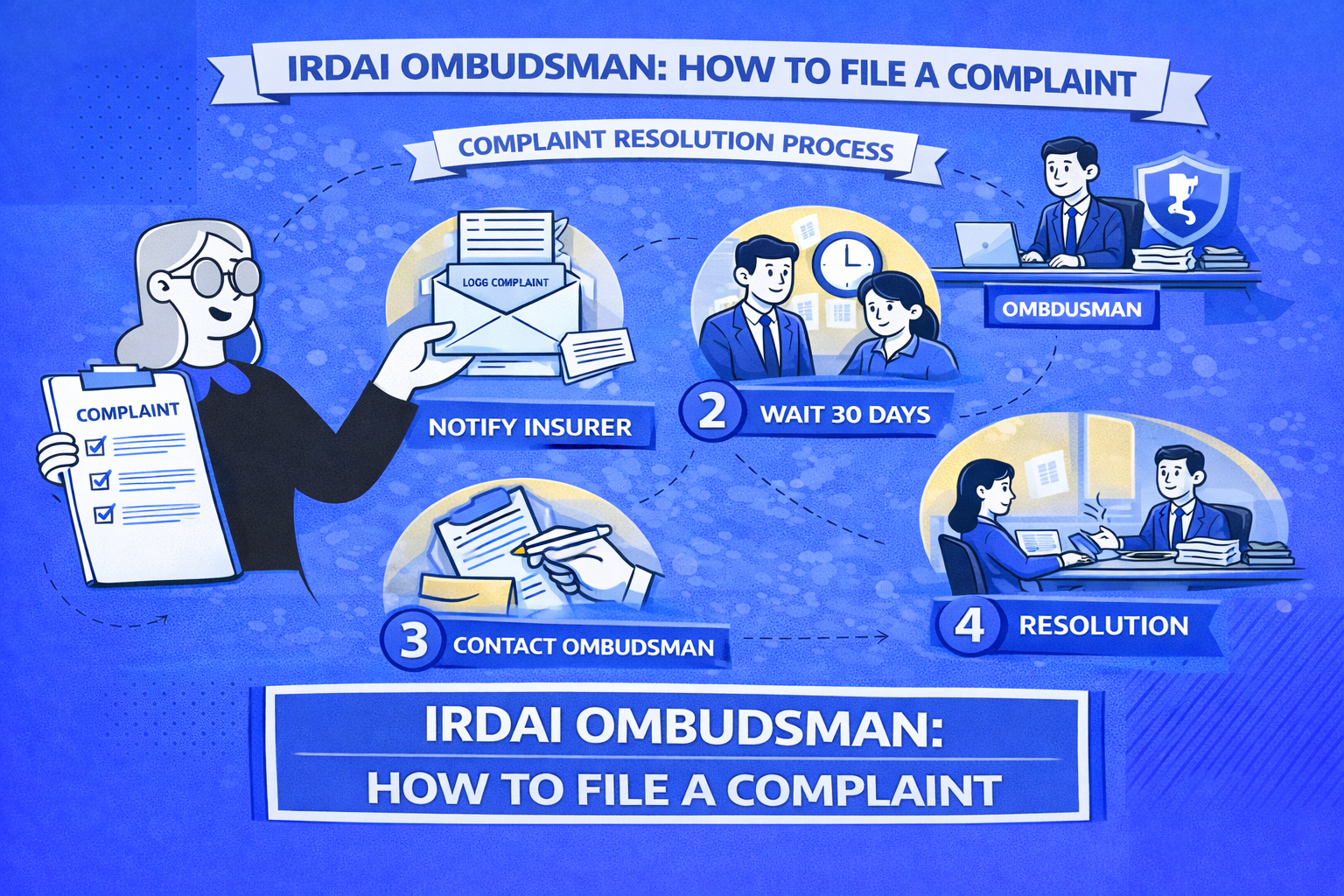
When a health insurance claim is rejected, partially paid, or grievance is unresolved after approaching the insurer directly, the Insurance Ombudsman offers a free, fast, and binding resolution path. The Ombudsman scheme is specifically designed for individual policyholders and operates independently of the insurer and IRDAI.
What the Insurance Ombudsman Is
The Insurance Ombudsman is an independent authority established under the Insurance Ombudsman Rules 2017 (amended 2021), under IRDAI’s oversight. Multiple Ombudsmen cover different geographical regions across India. Each Ombudsman has jurisdiction over insurance disputes from policyholders within their region.
Key features:
- Free for the complainant (no filing fee)
- Binding on the insurer (if the policyholder accepts the award)
- Faster than courts (3-month resolution timeline per IRDAI guidelines)
- Covers individual personal insurance: health, life, motor
- Maximum award up to ₹50 lakh (limit enhanced from ₹30 lakh by the 2021 amendment to the Insurance Ombudsman Rules)
Before Filing: Mandatory Pre-Requisite
The Ombudsman will not accept a complaint unless the following are completed:
-
Grievance filed with the insurer first: You must file a formal grievance with your insurer’s Grievance Redressal Officer (GRO) — by email, post, or the insurer’s online portal.
-
15-day waiting period: The insurer has 15 days to respond to the grievance. If they do not respond within 15 days, or if their response is unsatisfactory, you can proceed to the Ombudsman.
Document the grievance: Keep your grievance submission (email with timestamp, or postal acknowledgement), and any response from the insurer. These must be submitted with the Ombudsman complaint.
Step-by-Step: Filing an Ombudsman Complaint
Step 1: Identify the Correct Ombudsman
Ombudsmen are divided by geography. Your complaint must go to the Ombudsman with jurisdiction over:
- The address of the insurer’s branch where the policy was issued, OR
- Your residential address at the time of policy purchase
Ombudsman offices (as of 2026): Offices exist in major cities including Mumbai, Delhi, Kolkata, Chennai, Bengaluru, Hyderabad, Pune, Ahmedabad, Chandigarh, Bhopal, Jaipur, Lucknow, Kochi, Patna, Bhubaneswar, Guwahati, and Noida.
Current contact details are available at the Council for Insurance Ombudsmen website (ecoi.co.in) and at irdai.gov.in.
Step 2: Prepare Your Complaint
A well-prepared complaint includes:
Personal details:
- Full name, address, contact number
- Policy number and insurer name
Dispute details:
- Nature of dispute (rejected claim, partial payment, premium dispute, etc.)
- Amount in dispute
- Timeline of events (policy purchase date, claim event, rejection date, grievance filing date, insurer’s response)
Prayer (what you want):
- Specific relief requested (claim settlement, compensation, premium refund)
- Amount you are claiming
Supporting documents:
- Policy copy
- Claim form (if filed)
- Hospital bills and discharge summary
- Claim rejection letter with reasons
- Grievance submission proof and insurer’s response
- Any correspondence with the insurer
Step 3: Submit the Complaint
Online (preferred): Submit at the Bima Bharosa portal (bimabharosa.irdai.gov.in) — the integrated platform for insurance grievances managed by IRDAI.
Offline: Send by post to the Ombudsman’s office address with signed complaint and supporting documents.
Step 4: Attend the Hearing
The Ombudsman will schedule a hearing (in-person or online) where:
- You present your case and evidence
- The insurer’s representative presents their position
- The Ombudsman may ask questions and request additional information
You do not need a lawyer. Present facts clearly, reference specific policy clauses, and bring all supporting documents.
Step 5: Receive the Award
Within 3 months of the Ombudsman receiving all documents:
- A recommendation (conciliation) or final award is issued
- If a conciliation settlement is reached between you and the insurer, it is final
- If an award is issued by the Ombudsman, you have 30 days to accept or reject it
- If accepted, the insurer must comply within 15 days of your acceptance
- If rejected, you retain the right to pursue legal remedies
What the Ombudsman Can Resolve
Disputes within Ombudsman jurisdiction:
- Rejection of a claim (partial or full)
- Disputes about policy interpretation
- Delay in claim settlement beyond reasonable time
- Premium disputes (overcharging, refund denials)
- Non-issuance of policy document
- Grievances about policy terms misrepresented at sale
Outside Ombudsman jurisdiction:
- Corporate or group policyholder disputes (unless the complainant is an individual)
- Disputes involving a claim amount above ₹50 lakh total
- Matters already in court or tribunal
- Disputes beyond 1 year from final insurer response (or 3 years from initial rejection)
Other Escalation Options
| Level | Platform | Timeline |
|---|---|---|
| Level 1: Insurer GRO | Insurer’s portal / registered post | 15 days |
| Level 2: IRDAI IGMS | igms.irda.gov.in | 15 working days |
| Level 3: Ombudsman | bimabharosa.irdai.gov.in | 3 months |
| Level 4: Consumer Forum | Consumer Protection Act 2019 | Variable (6 months+) |
| Level 5: Civil Court | Standard civil litigation | Variable (years) |
The Ombudsman route is the most effective for claims below ₹50 lakh — free, faster than courts, and binding on the insurer.
Disclaimer: PolicyJack is an independent research platform. We do not sell insurance, receive commissions, or have commercial relationships with any insurer.