
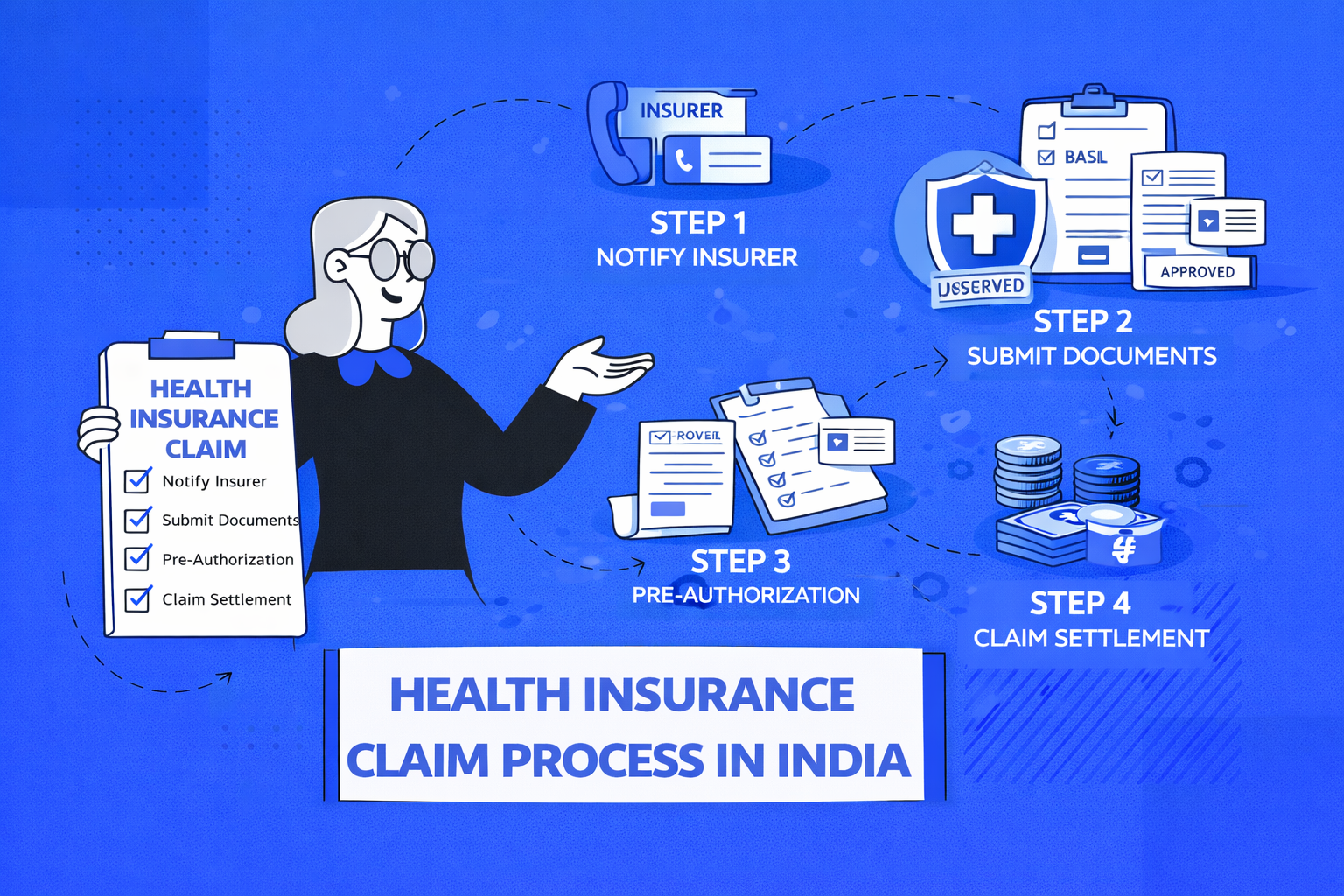
A health insurance claim is the moment the policy either delivers its promise or reveals its limits. IRDAI Annual Report 2023-24 records that health insurers received over 3.1 crore claim applications in FY24, of which approximately 8–12% were rejected or partially settled — a proportion that is preventable in most cases through process knowledge.
This guide covers the complete claim lifecycle for both cashless and reimbursement claims, with document requirements, timelines, and rights under IRDAI regulations.
Cashless Claim Process — Step by Step
Cashless settlement means the insurer pays the network hospital directly. You do not pay the covered hospitalisation bill.
Phase 1: Pre-Admission (Planned Procedures)
For elective surgeries or planned admissions:
Step 1: Contact the insurer/TPA helpline at least 3–5 working days before admission to initiate cashless authorisation.
Step 2: Hospital’s insurance desk requests pre-authorisation by submitting:
- Doctor’s admission advice with diagnosis
- Proposed procedure details
- Patient’s policy number and ID
Step 3: Insurer/TPA issues a Pre-Authorisation Letter (PAL) with:
- Approved condition / procedure
- Approximate approved amount (not final)
- Any conditions or exclusions noted
Important: The PAL is an estimate, not a final settlement. Actual claim settlement may differ based on final bills, applicable deductions, and policy terms.
Phase 2: Admission and Hospitalisation
Step 1: At admission counter, present:
- Health insurance card (physical or digital)
- Government-issued photo ID
- Pre-authorisation letter (for planned procedures)
- Referral letter from treating GP (if required by policy)
Step 2: Hospital marks your admission as insurance-covered. Request itemised billing tracking from day one — this matters at discharge.
Emergency admissions: No pre-authorisation required. The hospital or attendant must intimate the insurer within 24 hours of admission (or as soon as practically possible in critical emergencies).
Phase 3: Discharge and Final Settlement
Step 1: Request the itemised final bill and discharge summary on the day of discharge (not after).
Step 2: Hospital sends final claim package to TPA for post-hospitalisation authorisation.
Step 3: TPA processes against coverage terms:
- Applies room rent adjustment if applicable
- Deducts consumables (unless covered)
- Applies co-pay if applicable
- Issues final settlement amount
Step 4: Hospital confirms settlement from insurer. You pay only the non-covered amounts (consumables, room upgrade excess, co-pay, administrative charges).
Step 5: Collect original discharge summary, bills, and insurer settlement statement for your records.
Reimbursement Claim Process — Step by Step
Reimbursement claims apply when treated at a non-network hospital, when the cashless facility is unavailable, or when emergency circumstances prevent pre-authorisation.
Required Documents (Complete Checklist)
Mandatory for all reimbursement claims:
- Completed claim form (download from insurer website or obtain from TPA)
- Original discharge summary signed by treating doctor
- All original hospital bills (itemised, not summary)
- All pharmacy receipts with original prescriptions
- All diagnostic reports with request forms (doctor’s prescription for each test)
- Surgeon’s report / operation notes (for surgical cases)
- Attending doctor’s notes (progress notes during hospitalisation)
- Government ID of patient
- Original policy document or policy schedule
- Cancelled cheque / NEFT details for payment
- Pre/post hospitalisation bills within the covered time window
Additional for specific situations:
- Accident cases: FIR (if vehicle accident) or medico-legal report
- Pre-authorisation cases: original PAL and any amendments
- PED cases: previous medical records, prescriptions establishing condition
Submission Timelines
| Event | IRDAI-Mandated / Standard Deadline |
|---|---|
| Claim intimation | Within 30 days of discharge (check policy — some are 15 days) |
| Complete document submission | Within 15 days of intimation |
| Insurer acknowledgement | Within 3 working days of receipt |
| Final settlement / rejection | Within 30 days of complete document receipt |
| Surveyor (complex claims) | Within 45 days of surveyor report |
Reimbursement Process Steps
Step 1: Obtain claim form from insurer website or network TPA office.
Step 2: Arrange all original documents (list above). Do not send photocopies unless the insurer explicitly asks — file originals, keep photocopies yourself.
Step 3: Submit via registered post with acknowledgement receipt OR via insurer’s digital claim portal (if available). Note the date of submission.
Step 4: Follow up within 7 days if no acknowledgement. Keep a written communication record.
Step 5: If the insurer requests additional documents (a standard “query letter”), respond within the prescribed window (usually 15–30 days). Missing this window can cause the claim to lapse.
Step 6: On settlement, verify the settlement statement — ensure each deduction is clearly explained. Request a breakdown if unclear.
Top Reasons Health Insurance Claims Are Rejected
Understanding rejection causes is the best claim prevention tool:
1. Non-Disclosure of Pre-Existing Conditions
The most common basis for claim rejection. If a hospitalisation relates to a condition that existed before policy inception and was not declared, the insurer can reject and potentially void the policy. Prevention: Disclose all diagnosed conditions honestly at inception, even if you believe they’re minor.
2. Treatment During Waiting Period
A claim for a specifically excluded condition during the waiting period (PED, specific disease) is not payable under the policy terms. Prevention: Know your policy’s waiting period schedule before planning any procedure.
3. Policy Lapse / Non-Renewal
Continuous coverage is required. A lapsed policy — even by a few days — can result in claim rejection if hospitalisation occurs during the gap. Prevention: Set renewal reminders 30 days in advance. Auto-debit mandates prevent accidental lapses.
4. Treatment at Non-Network Hospital for Cashless Claim
A cashless claim at a hospital not in the insurer’s network will be denied. Prevention: Verify network status before admission for any planned procedure.
5. Excluded Treatment Type
Standard policy exclusions (cosmetic surgery, dental, OPD) — even if hospitalised — are not covered. Prevention: Read Section 10 (Exclusions) of the policy before planning any procedure.
6. Incomplete or Missing Documents
Reimbursement claims often stall due to missing original bills, unsigned discharge summaries, or absent diagnostic reports. Prevention: Collect all originals at discharge. Discharge summaries and operation notes must be collected before leaving the hospital — retrieval later is difficult.
7. Hospitalisation Not Medically Necessary
The insurer determines that the admission did not require hospitalisation — treatment could have been managed on OPD basis. Prevention: Ensure the treating doctor’s notes and discharge summary clearly document the medical necessity for in-patient admission.
Understanding What a TPA Does — and How to Work with One
A Third Party Administrator (TPA) is an IRDAI-licensed entity that processes claims on behalf of the insurer. Their role:
- Receives and processes cashless pre-authorisation requests
- Coordinates with network hospitals
- Reviews and processes reimbursement documents
- Issues initial settlement amounts
Working effectively with a TPA:
- Get all communications in writing (email preferred over calls)
- Record reference numbers for all cashless pre-authorisation conversations
- If the TPA denies a cashless request, immediately escalate to the insurer’s in-house claims or grievance team — the TPA is not the final authority
- If you feel you’ve been under-settled: request a written explanation from the TPA, then escalate to the insurer
IRDAI Consumer Rights — What to Do When Claims Are Rejected
Step 1: Internal Grievance (Insurer)
File a formal complaint with the insurer’s GRO (Grievance Redressal Officer), separate from the TPA. Insurers are required to respond within 15 days.
Step 2: IRDAI IGMS Portal
File a complaint at pgportal.gov.in or call the IRDAI Consumer Helpline: 1800-4254-732 (toll-free).
Step 3: Insurance Ombudsman
If the insurer’s resolution is unsatisfactory, file with the Insurance Ombudsman for the region. The Ombudsman handles disputes up to ₹30 lakh. No legal fee is required. The Ombudsman’s award is binding on the insurer.
Step 4: Consumer Court / Legal
For disputes above ₹30 lakh or non-compliance with Ombudsman award. Consumer Protection Act 2019 provides fast-track recourse.
Time limit: Ombudsman complaints must be filed within 1 year of receiving the final rejection from the insurer.
Pre and Post-Hospitalisation Cover — What’s Included
Most policies include:
Pre-hospitalisation expenses: Consultations, diagnostics, and medicines in the 30–60 days immediately preceding admission, for the same illness for which admission occurred.
Post-hospitalisation expenses: Follow-up consultations, physiotherapy, medicines in the 60–90 days following discharge.
Claim documentation must link these expenses to the hospitalisation episode. Submit pre/post bills as part of the primary hospitalisation claim package, not as a separate claim.