
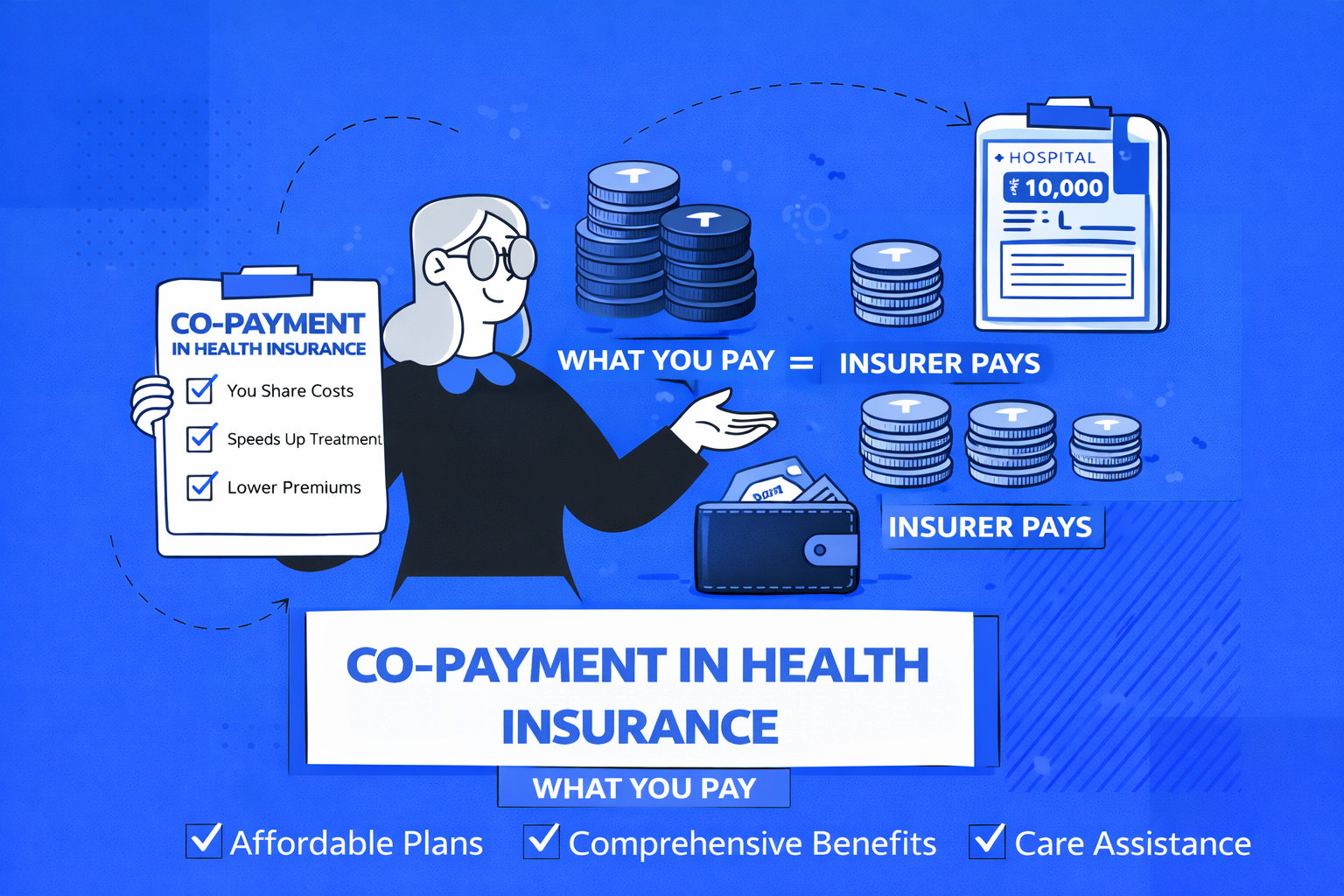
Co-payment in health insurance means you bear a defined percentage of every approved claim. It is a cost-sharing mechanism between the policyholder and the insurer. Understanding when co-payment is imposed, how much it costs on a real claim, and when voluntary co-pay makes financial sense is essential before selecting a health insurance plan.
What Co-Payment Means in Practice
Co-payment is expressed as a percentage of the approved claim amount. It is applied after the claim is assessed and approved — meaning after sub-limits, room rent proportionate deductions, and other adjustments.
Example:
- Hospital bill: ₹6 lakh
- After proportionate deduction (room rent): Approved claim ₹5.2 lakh
- Co-payment: 20%
- Your share: ₹1.04 lakh
- Insurer pays: ₹4.16 lakh
Co-payment is not a deductible (a fixed amount before coverage starts) — it is a proportional share of every claim, regardless of claim size. A ₹50,000 claim with 20% co-pay means ₹10,000 out of pocket. A ₹10 lakh claim with 20% co-pay means ₹2 lakh out of pocket.
Types of Co-Payment Clauses
1. Mandatory Co-Payment for Senior Citizens
The most common form. Many health insurance plans impose a mandatory co-payment (typically 10–20%) for policyholders above 60 at entry or above 65 at renewal. This is disclosed in the policy terms but is easy to miss in brochures.
IRDAI’s comprehensive policy regulations permit this practice. When comparing senior citizen plans, always check whether co-payment applies and at what percentage.
Plans with no co-payment for senior citizens typically have higher premiums than equivalent plans with co-pay. The premium saving from a co-pay plan vs no-co-pay plan should be weighed against the expected claim frequency and amount.
2. Non-Network Hospital Co-Payment
Many policies impose co-payment (10–20%) when treatment is at a hospital not in the insurer’s empanelled network. This incentivises use of network hospitals for cashless treatment. If you go to a non-network hospital and file for reimbursement, co-pay applies.
3. Zone-Based Co-Payment
Some plans price policies by geographic zone (e.g., Zone A for metros, Zone B for Tier-2 cities). If you purchase a Zone B policy (lower premium) and are treated at a Zone A hospital, a co-pay (typically 10–20%) is applied to the claim to compensate for the zone difference. This is a common source of claim disputes.
4. Specific Disease Co-Payment
Certain policies apply co-pay specifically for named diseases — psychiatric conditions, hernia, cataract, or other conditions that are commonly argued to be lifestyle-related. Read the Schedule of Benefits carefully for disease-specific co-pay clauses.
5. Voluntary Co-Payment
An optional structure where you elect to bear a percentage of claims in exchange for a lower premium. Common in:
- Budget-conscious buyers who are young and healthy
- High-SI policies where the buyer wants to reduce annual cost
- Group policies where employee co-contribution is designed into the plan
Premium Impact of Voluntary Co-Payment
| Co-Pay % | Typical Premium Reduction | Annual Saving (₹12,000 base premium) | Out-of-pocket on ₹5L claim |
|---|---|---|---|
| 0% (no co-pay) | — | — | ₹0 |
| 10% | ~10–15% | ~₹1,200–₹1,800 | ₹50,000 |
| 20% | ~20–30% | ~₹2,400–₹3,600 | ₹1,00,000 |
| 30% | ~30–40% | ~₹3,600–₹4,800 | ₹1,50,000 |
Premium figures are illustrative. Actual discounts vary significantly by insurer, age, and SI.
The decision to opt for voluntary co-pay should be based on a simple calculation: multiply your expected claim size (even if uncertain) by the co-pay percentage and compare to the annual premium saving.
How to Identify Co-Payment in a Policy
Step 1: Look in the Schedule of Benefits (first few pages of the policy document) for a row labelled “Co-Payment” or “Patient Share.”
Step 2: Read the Definitions section for the definition of “Co-Pay” — this will specify whether it applies to all claims, only certain types, or only in specific scenarios.
Step 3: Check the Exclusions and Conditions section for disease-specific or zone-based co-pay conditions.
What to ask before purchasing:
- “Does this policy have any co-payment clause?”
- “Is co-payment applicable for all claims or only specific types?”
- “If I am treated at a non-network hospital, what is the co-pay?”
- “Does co-pay increase at renewal as the policyholder ages?”
Comparing Plans on Co-Payment
When comparing two plans where one has co-pay and one does not:
- Calculate the premium difference over 3 years (the relevant comparison window given 3-year PED waiting periods)
- Estimate your expected claim scenarios (routine, moderate, large)
- Apply co-pay to each scenario and calculate the cumulative out-of-pocket
- Compare: cumulative premium saving vs cumulative co-pay exposure
In most scenarios, for buyers above 50 or with declared health conditions, avoiding co-pay is worth the additional premium.
Disclaimer: PolicyJack is an independent research platform. We do not sell insurance, receive commissions, or have commercial relationships with any insurer.